

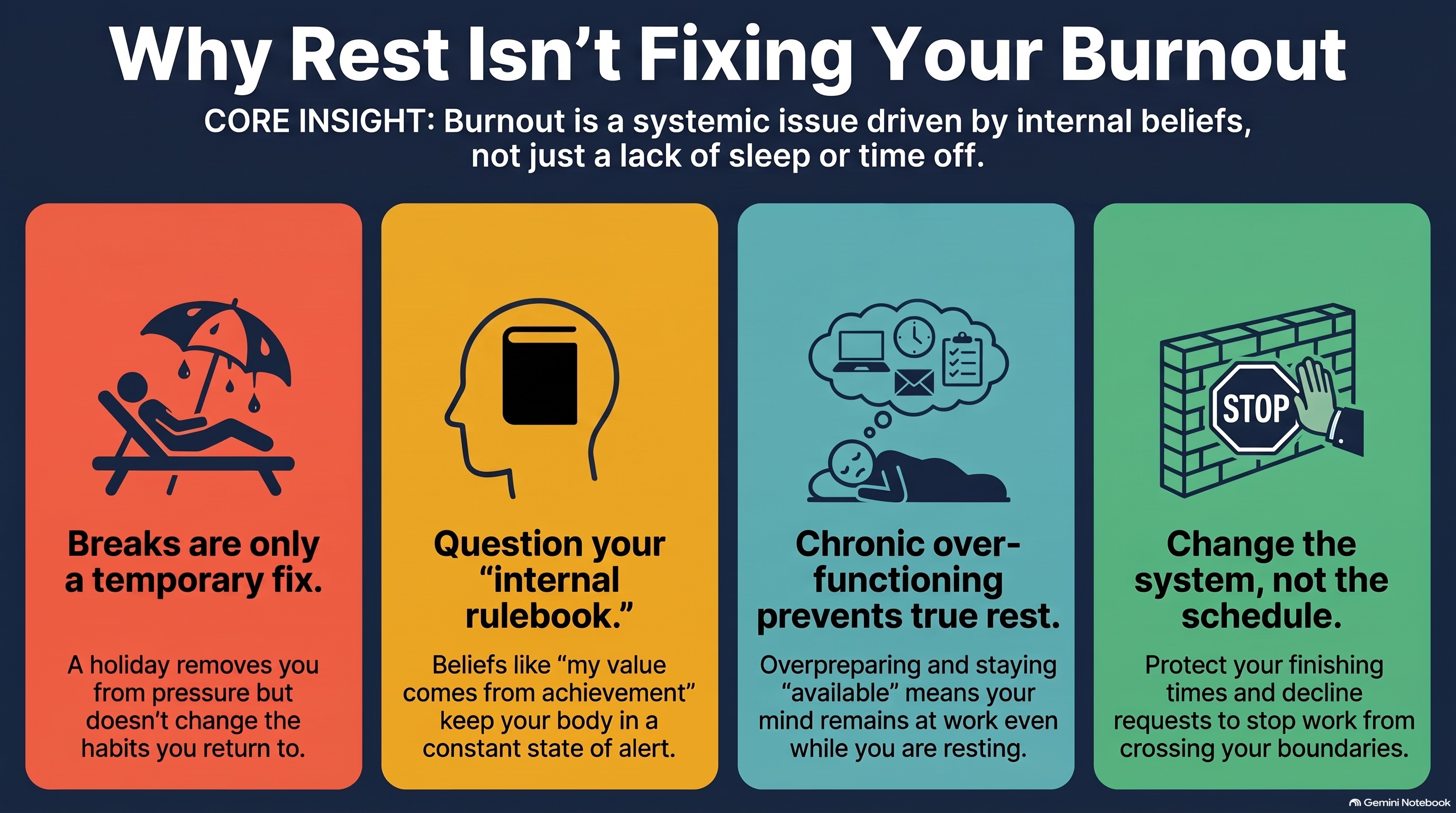
Burnout is often treated as a workload problem. Work fewer hours, take a holiday, sleep more and you should feel better.
But for many high-achieving professionals over 50, the relief does not last.
You return to work and quickly fall back into the same routines. You accept too much responsibility, remain constantly available and continue putting your health behind every meeting, deadline and request.
Eventually, even rest stops feeling restorative.
The deeper problem is not always how much you are doing. It can be the story behind why you feel compelled to keep doing it:
I must prove I am good enough.
I cannot disappoint anyone.
If I slow down, everything will fall apart.
My value comes from what I achieve.
I should be able to cope.
These beliefs may have helped you become successful and dependable. But they can also leave your mind and body in a constant state of alert.
A Different Way Forward
My WISDOM philosophy helps identify the real barrier preventing you from taking consistent action:
Willingness: Are you prepared to protect your health, even when it feels uncomfortable?
Identity: Are you still trying to be the person who never says no?
Simple: Is your health plan realistic during a demanding week?
Design: Does your environment support recovery or keep you connected to work?
Overcome: Do you have a minimum plan for difficult days?
Mindset: Do you see exhaustion as weakness or useful feedback?
One client came to me believing he needed a more demanding health plan. In reality, his plan kept collapsing whenever work became busy.
We reduced it to two manageable strength sessions, regular walks and a clear boundary between work and the evening. Instead of abandoning everything during pressured weeks, he had a simpler version he could continue doing.
He began to feel more in control of his health without stepping away from his professional responsibilities. His success did not come from trying harder. It came from creating a plan that worked within his real life.
That is often the shift people need. The objective is not to abandon your ambition. It is to become someone who can remain ambitious without sacrificing their health to prove it.
Your Next Step
If you are over 50 and know what you should be doing but struggle to do it consistently, the CapabilitySpan Assessment can help identify where your health needs the most support.
Ask yourself:
What is preventing me from taking the action that matters, and what is the simplest useful change I can test next?
Take my CapabilitySpan Assessment and use your results to decide what needs to change first.
Chris Deavin, Owner, myHealthCoach
🎧 Listen weekly on The Resilient Life Podcast
🌐 Learn more at www.myhealthcoach.online
📩 Subscribe to myHealthCoach Substack for insights, guides, and real client stories: